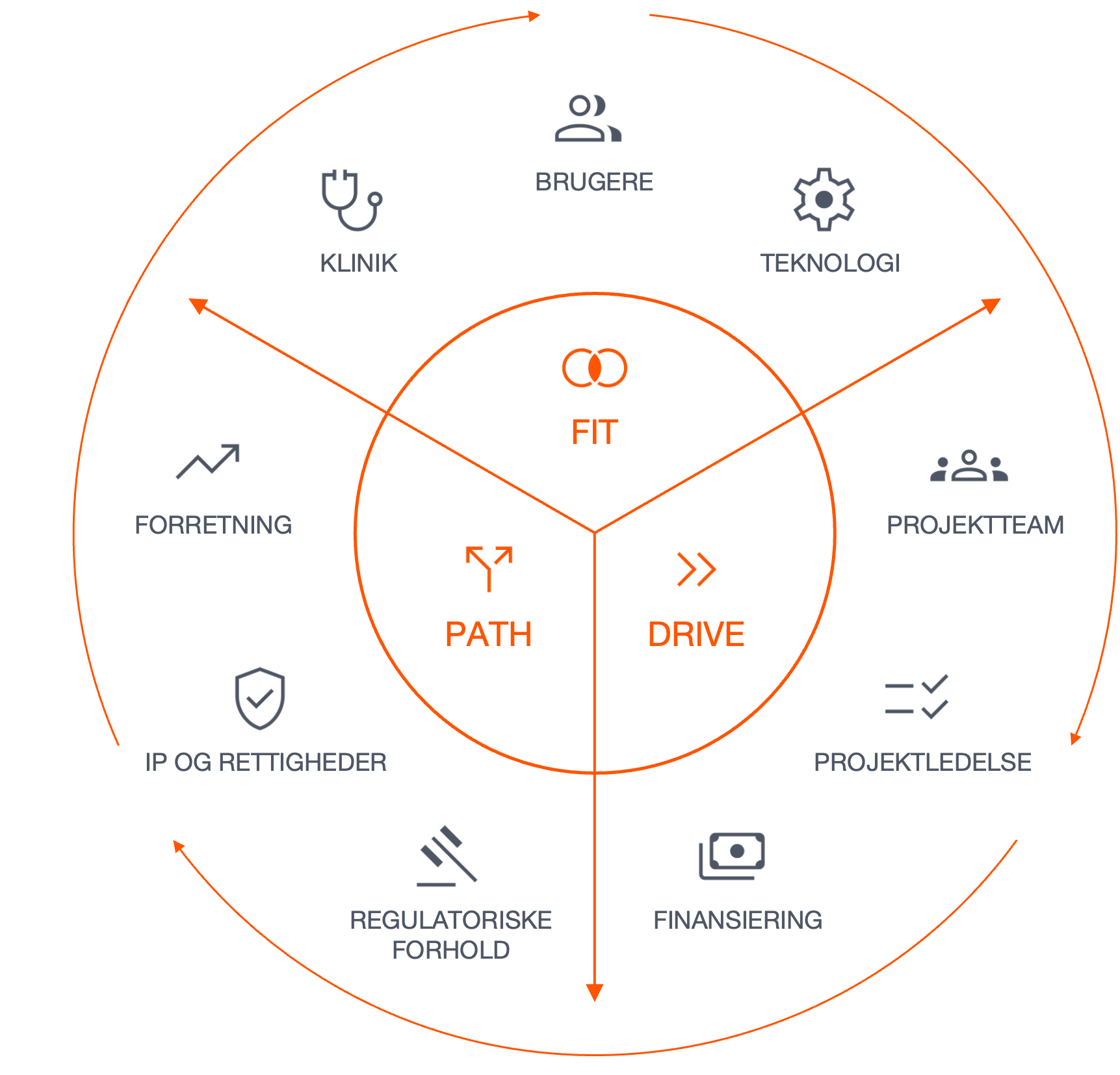
Users
End-user behavior and real-world needs – ensuring the solution fits into a busy clinical workflow and is actually adopted.
The Users dimension describes how well the project understands user needs and usage scenarios, and whether the solution fits their practice and is used over time. There is always a user of the solution. We distinguish between two user roles:
1. Active user: The person who uses the solution or whose work is changed by it.
2. Passive user: The person affected by the solution's outcome without necessarily using it themselves. There may be multiple user groups, or just one group that is both active and passive. For a patient app, for example, the patient may have both roles.

Technology
From early concept to a functional, secure, and scalable solution that can be operated reliably within the hospital.
The Technology dimension describes the development stage of a solution and the extent to which it is documented to function as intended.
This dimension tracks progress from initial technical concepts and prototypes to a finished solution that operates reliably in daily use. It encompasses physical equipment, software, digital systems, and other tangible solutions or methods.
The focus is on the solution's functions, technical specifications, and integration with its intended environment. Clinical impact, user adoption, and regulatory compliance are assessed under Clinical, Users, and Regulatory respectively.

Clinical
Clinical evidence. Without strong clinical validation, the solution will never be implemented.
The Clinical dimension describes the documentation for the clinical problem, the expected benefits, and the solution's clinical impact and safety within the patient group and clinical context where it is to be used.
The dimension spans from understanding the need and selecting relevant clinical goals to testing, validation, and documentation of impact in routine clinical practice.
Clinical documentation is assessed here. Technical function, user application, and regulatory matters are assessed under Technology, Users, and Regulatory matters, respectively.
Clinical value can, for example, be improved patient outcomes, diagnostic precision, patient safety, or quality in clinical decision-making. It can also be maintained quality and safety with lower resource consumption, if that is the purpose of the solution.

Business
Value proposition, health economic benefit, and business model – is there an incentive to procure and scale?
The Business dimension examines whether there is an economic and organizational basis for the solution to be selected, funded, adopted, and scaled. This includes understanding the customer, the value the solution creates, and the opportunities for internal implementation, partnership, or commercial rollout. Relevant environmental impacts are also included.
The customer is the person, entity, or organization that pays, holds budget responsibility, or makes the decision to adopt the solution.
Maturity evolves from an initial assessment of the economic and organizational consequences of the problem to dialogue with customers, documentation of value, a proven business case and funding model, as well as agreements, actual use, and scaling.

IP and rights
Patents and trademarks protect your invention and are a requirement if you want to attract industry partners or investors.
The IP and rights dimension describes how well the project has clarified and managed the intellectual property rights necessary to develop, apply, and advance the solution.
This applies to both rights to the project's own results and the right to use those of others. It includes, for example, ownership, authorship, protection options, access to existing technology, and licensing and collaboration agreements.
In hospital projects, the institution's Technology Transfer Office (TTO) or equivalent function plays a central role in assessing inventions, ownership, protection, and potential licensing. Involve this function early when the project involves questions regarding these matters.
The IP and rights dimension encompasses more than just patents. Copyright, design protection, trademarks, confidential knowledge, and rights to and access to datasets and databases may also be relevant. The rights must support the solution's planned implementation. Access to data during research or testing does not in itself mean that the data may also be used when the solution is put into actual use.

Regulatory affairs
MDR, CE marking, and GDPR clarified early on, ensuring the solution can be legally used on patients.
The Regulatory Affairs dimension describes the project's progress in clarifying and meeting the rules and regulatory requirements necessary to implement the solution and ensure its continued legal use.
This dimension includes, among other things, the solution's intended purpose, classification, documentation and risk management requirements, and relevant quality systems. Regulations concerning personal data, artificial intelligence, cybersecurity, and other matters are included where relevant.
This dimension is also relevant for solutions that are not medical devices. In these cases, the rules and requirements applicable to the specific solution are assessed, such as those concerning personal data, information security, or medical record-keeping.

Project Team
The right clinical, technical, and commercial competencies. Investors value the team just as highly as the idea.
The Project Team dimension describes whether the project has the competencies, time, and collaboration required to develop and advance the solution. This dimension assesses both the project group's own resources and access to necessary expertise from the hospital, advisors, and partners. Leadership and decision-making structures are assessed under the Project Management dimension, while rights are assessed under the IP and Rights dimension.

Project Management
Governance, milestones, and management support that carry the project from pilot to full implementation.
The Project Management dimension describes the project's ability to set direction, delegate responsibility, make decisions, and ensure progress.
This dimension covers how work is managed and monitored: planning, prioritization, accountability, risks, resources, and collaboration. The management task evolves as the project moves from an exploratory startup phase to development, implementation, and operations.

Funding
A capital plan – from early grants to larger funds or investors – to ensure development doesn't stall.
The Funding dimension describes whether the project has access to the money and other resources necessary for the development, testing, implementation, and continued operation of the solution.
This includes budgets, funding opportunities, applications, agreements, and expenditure monitoring. Allocated staff time, equipment, and other contributions from the hospital also count as resources.
Secured funding means that the project has documented access to the necessary funds or resources for the planned activities. It must be clear what these cover, for what period, and under what significant conditions. Revenue from the solution's use and its economic sustainability are assessed in the Business dimension.
Funding does not have to consist of separate project funds. Allocated staff time, other agreed-upon resources, and operating budgets can cover the need if they are available for the planned activities.